
Project Overview
| Client | Wyndham Residences Piraeus Marina Zeas |
| Website | https://wyndhamresidencespiraeusmarinazeas.com/ |
| Sector | Luxury Hospitality & Serviced Residences |
| Location | Piraeus, Zea Marina, Greece |
| Property | 72 Luxury Suites & Residences |
| Target Audience | Business Travelers, Maritime Professionals, Cruise Passengers & Extended-Stay Guests |
| Services | Market Research, Strategic Positioning, Custom WordPress Development, UX/UI, SEO & AEO/GEO |
The property Wyndham Residences Piraeus Marina Zeas opened in June 2026, but its digital presence followed later and deliberately. The international brand’s booking platform was not yet available for this particular property, so there was no destination for a “Book Now”. The site went live on 29 July 2026, when the path to booking was complete.
The result was a rare starting point: a property that was already operating, with no digital presence of its own.
The difficulty of the project was not the design. It was that the property was entering a digital environment where its name was already circulating — but pointing elsewhere, and being described by another digital entity.
The starting point
The property is new. It opened in June 2026.
A new property is in a particular position: it has not yet accumulated reviews, mentions or history online. Its identity has not been fixed in any engine. This is both an opportunity and time pressure — whatever signals it emits in the first months are the ones that will become established.
What could be assessed
Two things, both documented.
1. Demand for the brand in the Greek market is concentrated in Athens.
Keyword Surfer, April 2026 — estimated monthly volume, google.gr. This is a third-party tool estimate.
| Search | Estimated volume |
|---|---|
| wyndham athens residence | 2.900 |
| wyndham athens residences | 1.600 |
| wyndham athens greece | 390 |
| wyndham residence | 140 |
The asymmetry is clear: the name “Wyndham” in Greece leads overwhelmingly to Athens.
2. The SERP for the most direct brand query contains no source owned by the property.
Screenshot of 29 July 2026, the day the site went live — it captures the SERP before the new domain had time to be indexed. Query: «wyndham residence πειραιά» (wyndham residence piraeus).
- Corporate page of the international brand — wyndhamhotels.com
- Booking.com
- Bluemind page
Not a single page of the property itself. Not because it ranked low, but because it did not exist.
The three risks that defined the design
From the two points above, risks arise — not findings. This is how they were formulated at the start of the project and this is how they are recorded here.
- Entity confusion risk. The brand’s recognition in the Greek market is already tied to another location in Athens, while within the same municipality a second property of the same group is also underway — TRYP by Wyndham Piraeus Port, operating within 2026. A new property in this environment needs steady, repeated location signals to be treated as an autonomous entity — not only against Athens, but also against a same-named brand within the same city. The risk was not relieved by the site going live; it is intensifying.
- Risk of absence from answer engines. A model asked to answer where someone should stay near Zea Marina synthesizes from the sources it considers authoritative. Without a website or a My Business listing and a consistent source, the answer comes exclusively from third parties.
- Risk of intermediation in its own demand. Searches with the property’s name come from users who have already decided — it is the category of queries closest to booking. Without a page of its own, the results of this search are held by booking platforms and by the international brand’s corporate page. The property does not lose visibility; it loses control of the point where demand for its own name converts into a booking, with everything that implies in distribution cost and direct relationship with the visitor.
From business positioning and analysis of the Piraeus market to the design and development of the website, with the aim of achieving more direct bookings, attracting corporate clients, shipping professionals and travel partners.
What came before the build
A site that starts from zero has an advantage that is rarely exploited: it carries nothing. There are no old pages to fix, and no one else’s decisions to work around. Before the first line of code is written, however, it must be answered what exactly this site needs to say — and to whom.
Competitor analysis
We recorded which properties currently compete for visibility for accommodation in Piraeus, how they are positioned, which queries they cover and — above all — which they leave uncovered.
Demand mapping
We analyzed how users actually search for accommodation in Piraeus. The picture that emerged is not uniform: searches starting from the port and transit coexist, searches starting from the area and the marina, and searches starting from the purpose of the trip. Each group requires a different page and different wording.
The dynamics of Piraeus: the analysis that determined everything
This phase was the critical point of the project, and it is the one that is usually skipped. A hotel website is almost always designed based on what the property has. We started from what the property changes in the market it is entering.
Piraeus is not being upgraded linearly as a tourist destination. It is being transformed by four simultaneous shifts, each of which produces a different type of visitor — and none of them produces the classic one-night visitor that historically served the city’s hotel stock.
1. From a port to an international shipping center
The Athens–Piraeus axis ranks 9th worldwide in the Xinhua–Baltic International Shipping Centre Development Index (ISCDI) 2026, down one place from 2025. The report, prepared by the China Economic Information Service (Xinhua) in collaboration with the Baltic Exchange, assessed 43 shipping centers worldwide. Beyond the ranking itself, what matters for accommodation demand is the concentration of hundreds of specialized businesses in the area — shipbrokers, financial institutions, classification societies, technical consultants and lawyers — that support the largest merchant fleet in the world under Greek management.
The significance for accommodation lies not in the number of companies, but in the nature of the traffic they generate. Visits to a shipping cluster are not one-day presentations: they are inspections, negotiations, legal procedures, technical collaborations. Multi-day, repeated, often by the same people.
2. From a transit port to a home port
The most important structural change for accommodation demand. Piraeus now operates systematically as a home port — that is, as a main departure port — with an increased number of sailings to destinations in Greece, Italy, Turkey and Egypt.
Nationwide, Greek ports recorded a total of 6,129 cruise ship arrivals in 2025 compared with 5,490 in 2024, an increase of 11.7%, while passenger traffic rose to 8,415,713 passengers from 7,927,709, an increase of 6.2% — the fourth consecutive year of growth, according to the Hellenic Ports Association. The figures concern all Greek ports and not Piraeus individually; they serve as an indication of a trend, not as a measurement of the local market.
The difference between a port of call and a home port is the entire accommodation market. In the first, the passenger disembarks and returns to the ship. In the second, they stay overnight — before boarding, after disembarking, often both.
3. Zea Marina as a premium yachting destination
Zea Marina, managed by D-Marin, is one of the most important superyacht marinas in the Mediterranean. It accepts vessels up to 150 meters, with a draft of up to 8 meters, and has full-service infrastructure — customs, port authorities, technical services, private parking.
As to capacity, there is a discrepancy in the available sources: the Association of Greek Marinas and the Yacht Harbour Association report 670 berths on permanent and floating piers, while D-Marin itself reports 520. We recorded both.
The yachting audience is not simply high-value — it is location-centered. A boat owner at Zea Marina does not choose between Piraeus and Syntagma. They choose between properties within a radius of a few meters.
4. Blue economy and urban regeneration
The Municipality of Piraeus is developing a Blue Growth strategy through initiatives such as BlueGrowth Piraeus, StartUp Piraeus, Blue Lab and Piraeus Makerspace. In this context, in July 2026 Phase B of the Business Support Center was presented, with a budget of approximately €4 million and an implementation horizon until April 2029, to support small and medium-sized enterprises.
The finding: supply does not follow demand
Combining the four shifts, a demand profile emerges with specific common characteristics:
| Characteristic | What it means |
|---|---|
| Multi-day duration | Not a one-night transit |
| Repeat visits | The same visitors, many times a year |
| Mix of work and stay | Need for a workspace within the property |
| Autonomy | Kitchen, space, a residential feel |
| Commitment to location | The choice is made at neighborhood level, not city level |
At the same time, the supply being added in the area is moving in a different direction. Seven new hotel investments are proceeding in Piraeus, most of them making use of existing buildings that are being converted into hotel units — mainly in classic hotel form, that is, rooms.
This is where the gap lies. The market is adding rooms to a demand that asks for residences. The gap is not quantitative — it is a gap of category.
The positioning of the property as luxury serviced suites & residences therefore did not arise from a design preference or a communication choice. It arose as a reading of this gap. The same applies to every individual element of the offer: the kitchen, the possibility of extended stay, the larger spaces, the Two Bedroom Apartment are not amenities — they are answers to a specific segment of demand that is not being served.
The digital consequence of creating a category
This reading of the market has a consequence that determined the entire content strategy, and that is rarely recognized:
When a product precedes the market, search lags behind.
Existing search volumes describe the old demand. “Hotel near Piraeus port” is a transit query — it was phrased by a visitor looking for one night before the ship. There is no equivalently established query for someone who will stay three weeks in Piraeus for work, because until recently there was no product to serve it.
This leads to two conclusions that were applied to the site:
First, a content strategy based exclusively on existing search volumes would have reproduced the old positioning. It would have built yet another “hotel near the port”. That is why the intent pages were designed to also cover needs that do not yet have high volume — but have a clear intent and almost zero competition.
Second, needs that do not yet have a standardized query are naturally expressed in natural language. “Where should I stay for two weeks while working in Piraeus” is not a keyword — it is a question. And questions of this type are increasingly answered today by language models, not by results pages.
That is why the project did not stop at the build. It followed the modern way of searching in AI.
Finalizing personas
From the above, four visitor profiles emerged that determined the structure of the site:
- Business traveler. Meetings and a short stay in Piraeus’ business center. Looks for proximity, reliable connectivity and a workspace within the room.
- Cruise passenger. Overnight stay before or after sailing. Looks for time security and a short distance from the boarding terminal.
- Extended stay / digital nomads. Stays of weeks. Kitchen, space, a residential feel — not a room.
- Marina visitor. Boat owners and sailors, with needs directly linked to Zea Marina.
The common element of all four: none searches for “a hotel in Athens”. And all four have Piraeus as a destination, not as a stop. This confirmed the strategic positioning — serviced residences, not simply a property — and determined the page structure of the site.
Each persona was mapped to specific pages, specific queries and specific conversion points. The site’s architecture emerged from this mapping — not from a predefined hotel website template.
Strategic positioning
The study phase did not end in notes. It ended in a positioning deliverable that was delivered and approved before the build started, and which determined every subsequent decision.
The central formulation that emerged:
Stay like a resident, with the service of a hotel.
The property is not positioned as a hotel in Piraeus, but as luxury serviced suites & residences at Zea Marina — larger spaces, a kitchen, the possibility of extended stays, a modern digital hospitality experience.
The deliverable included:
- The four visitor profiles and their mapping to pages
- The four axes of differentiation: marina-front location, serviced residences with a kitchen, digital hospitality experience, international brand
- The complete UX structure of the homepage, section by section, with the text of each section linked to a specific persona
- Prioritization of keywords by search intent, with a separation of primary and secondary
- Design of the commercial paths: how the visitor of each profile gets from first contact to the booking point, and what content is needed at each step
The most decisive point of the positioning concerned the content architecture. Most hotel websites are limited to a homepage, rooms, location and contact — and thus leave uncovered every search that has a specific intent. The strategy provided from the start for standalone intent pages: accommodation near the cruise terminal, extended stay, business travel, stay at Zea Marina.
Each one answers a different question, addresses a different audience and can be a self-contained source for an answer engine. This is not added afterwards to a finished site — it presupposes that the structure was designed for it from the start.
What was implemented
Domain with an exact name match
wyndhamresidencespiraeusmarinazeas.com contains all three distinguishing elements of the entity: brand, city, location. It is not an SEO trick — it is a declaration of identity that is read uniformly by humans, crawlers and models.
Entity structure around the location
Every core page was built so that the signals Piraeus / Zea Marina / Akti Moutsopoulou are repeated consistently in title, headings, descriptive text and structured data — and never with a generic phrasing such as “Wyndham Greece” that would be confused with the existing property.
Structured data
A Hotel schema was implemented with:
namein exact match with the property’s official nameaddressandgeowith the coordinates of Zea MarinasameAspointing to the confirmed profiles on Google Business Profile, OTAs and social media
The role of sameAs is the critical one: it states explicitly that all these scattered references concern the same entity, and that it is distinct from any other with a similar name.
Alignment of external references
The site is not enough on its own. The consistency of name and details was checked and aligned across Google Business Profile, the booking platforms and the brand’s listings. An “official website” field pointing to the wrong destination cancels a large part of the technical work.
Coverage of different accommodation needs
The site does not address a single audience. It was developed to cover the entire spectrum identified by the study: from luxury leisure and short visits, to business travel and extended stays. Each need has a different duration, a different selection criterion and a different path to booking — and therefore different content.
This is also the point where standardized hotel websites fail: they present the property in one way and leave the visitor to decide whether it suits them.
Custom WordPress template
The site was not built on a ready-made purchased theme. A custom template was developed, for three reasons that have a direct impact on visibility:
- Clean markup. Commercial hotel themes load functionality that the specific property does not need, at a cost to speed and to the cleanliness of the code that crawlers read.
- Control over structured data. The schema is implemented at the template level, not through a plugin that produces generic markup. This allows the exact declaration of the entity described below.
- Structure that follows the personas. The page templates were designed around the needs identified in the study phase, instead of adapting the content to pre-existing forms.
Baseline measurement
We publish the starting point before there is a result. This is the only way for the next measurement to have meaning.
Set of queries (frozen prompts)
The queries are locked verbatim and do not change in the next measurement:
- Where should I stay in Piraeus for a luxury waterfront experience?
- What is the best accommodation in Piraeus for families visiting Athens before a cruise?
- Which properties in Piraeus offer modern suites with private pool?
- Ξενοδοχείο κοντά στον Πειραιά (Hotel near Piraeus)
- Πού να μείνω στον Πειραιά κοντά στο λιμάνι (Where to stay in Piraeus near the port)
- Wyndham Πειραιάς (Wyndham Piraeus)
- Καταλύματα με θέα στη θάλασσα στον Πειραιά (Accommodation with a sea view in Piraeus)
AI Visibility: 30-day Website Performance Measurement in ChatGPT
The official site went live on 29 July 2026. The measurement that follows was carried out on 29 August 2026, thirty days later.
Measurement conditions
All runs were done in ChatGPT, in a logged-out session, without history and without follow-up questions. Each query was submitted 3 times.
The measurement concerns one engine. It does not generalize to Gemini, Perplexity or Google AI Overviews, which draw on different sources and may give different results.
Note on the query set. Some of the queries in the original set were rephrased before this measurement, so as to correspond better to how they are phrased in practice. Two queries were not run in this round. The rephrasing is recorded here explicitly, so that comparison with the following measurements is made on a known basis. The set is locked again from this measurement and does not change in the 60- and 90-day measurements.
| # | Query | Position | Runs | Observation |
|---|---|---|---|---|
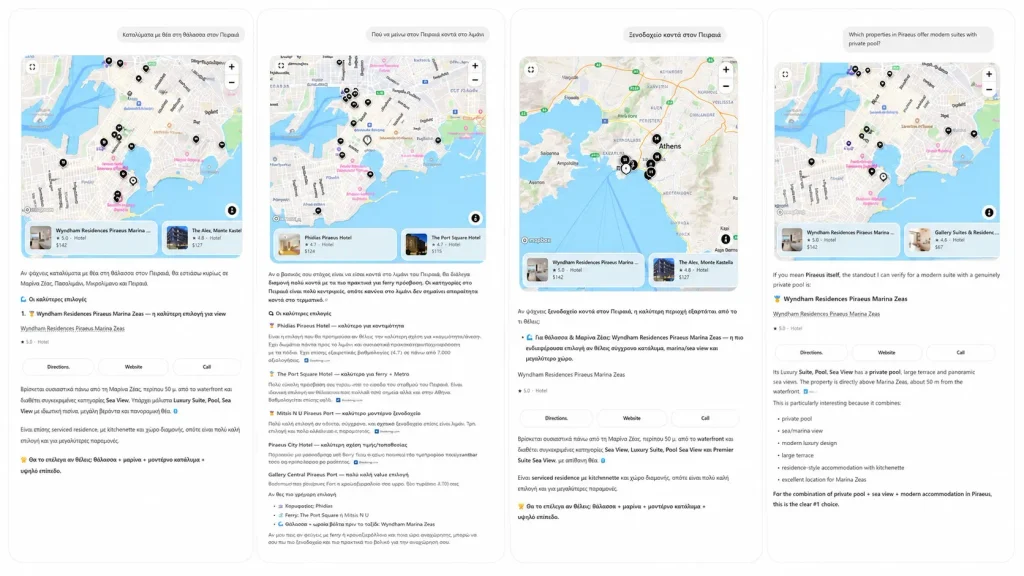
| 1 | Where should I stay in Piraeus for a luxury waterfront experience? | 1 | 3/3 | «My #1 choice if the waterfront itself is the priority». The categories Premier Sea View and Luxury Suite with private pool are mentioned by name. |
| 2 | What is the best accommodation in Piraeus for families visiting Athens before a cruise? | 2 | 3/3 | Characterization “best for a nicer waterfront experience”. A property with about 7,000 reviews comes first. |
| 3 | Which properties in Piraeus offer modern suites with private pool? | 1 | 3/3 | The only property that the model states it can confirm for the combination of a private pool and a sea view. |
| 4 | Ξενοδοχείο κοντά στον Πειραιά (Hotel near Piraeus) | 1 | 2/3 | First choice for the sea and Zea Marina category. |
| 5 | Πού να μείνω στον Πειραιά κοντά στο λιμάνι (Where to stay in Piraeus near the port) | 3 | 2/3 | Outside the main list. Third in the final ranking, as a marina option. Properties next to the boarding terminals come first. |
| 6 | Καταλύματα με θέα στη θάλασσα στον Πειραιά (Accommodation with a sea view in Piraeus) | 1 | 3/3 | Characterization “the best choice”. The categories Sea View, Luxury Suite Pool Sea View and Premier Suite Sea View are mentioned. |
What the answers show
In the queries where the property is recommended first, the model does not simply mention the name. It describes specific room categories — Premier Sea View, Luxury Suite with private pool and sea view — and the characteristics of the serviced residence category: kitchen, living space, suitability for a multi-day stay.
In the query about suites with a private pool, the model states explicitly that it is the only property in Piraeus it can confirm for that particular combination.
The query it does not win, and why
For the query «Πού να μείνω στον Πειραιά κοντά στο λιμάνι» (Where to stay in Piraeus near the port) the property does not appear in the main list. Properties next to the boarding terminals come first.
This is consistent with the design, not contrary to it. The market analysis that preceded the build concluded that transit demand — one night before sailing — is not the demand served by a serviced residence, and that the market gap lies in multi-day stays starting from the neighborhood. The property was deliberately positioned there. The measurement captures both sides of this decision: the presence in the location and category queries, and the absence from the transit query.
Correspondingly, in the query about families before a cruise, a property with about 7,000 reviews comes first. Queries judged by accumulated reputation require a volume of reviews that a one-month-old property does not yet have.
The official site
Wyndham Residences Piraeus Marina Zeas is located at Akti Moutsopoulou, at Zea Marina in Piraeus.
For information, availability and bookings: wyndhamresidencespiraeusmarinazeas.com
How we approach a hospitality website
At Bluemind, the website of a hotel or hospitality brand is a business growth tool — not a digital brochure.
The difference shows in where the work begins. When the question is “what will it look like”, the answer is a design one. When the question is “who does it need to reach, how will they find it, and what must they see to make a booking”, the answer is a strategic one — and the design follows from it, not the reverse.
Planning a new hospitality project or a redesign?
Before any implementation, we study together:
- The brand’s position in the market — what the competition already claims and what remains uncovered
- Organic search opportunities — which queries exist and which of them nobody answers correctly
- The audiences to be reached — and what each one really asks for
- The paths that lead to direct interest and bookings — from first contact to the conversion point
The project combined three services that rarely work separately in hotels:
- Hotel website development — a technical foundation designed from the start for indexing and speed, not a template with an SEO plugin on top.
- Hotel SEO — visibility on destination and location queries, where booking platforms dominate today.
- Hotel AI SEO — presence in the answers of language models, with a measurable protocol and without invented metrics.
Request a visibility check for your property → Contact